
Have you ever wondered how raw gold transforms into the stunning jewelry we wear every day? One of the most important methods used in jewelry manufacturing is the casting process. It allows jewelers to create detailed designs with precision and consistency, turning ideas into beautiful finished pieces. Let’s break down the process in simple terms.
What Is Jewelry Casting?
Casting is the method of pouring molten metal into a mold to create a specific shape. It is widely used for gold, silver, platinum, and other metals to make rings, bangles, necklaces, and intricate decorative pieces.
Think of it as baking a cake—you pour batter into a mold, and once it’s set, it takes the shape of the mold. In jewelry, molten metal replaces the batter, and the mold determines the design.
Steps of the Casting Process
-
Design Creation
The process starts with a design, which can be made by hand, CAD (Computer-Aided Design), or a combination of both. This design determines the shape and details of the jewelry piece. -
Making a Wax Model
A wax model of the jewelry is created. This model is an exact replica of the final piece. Wax is easy to shape, allowing for intricate designs. -
Investment and Mold Making
The wax model is coated with a heat-resistant material called investment, which hardens to form a mold around the wax. Once hardened, the wax is melted out—leaving a hollow cavity in the shape of the jewelry design. This step is often called the lost-wax method. -
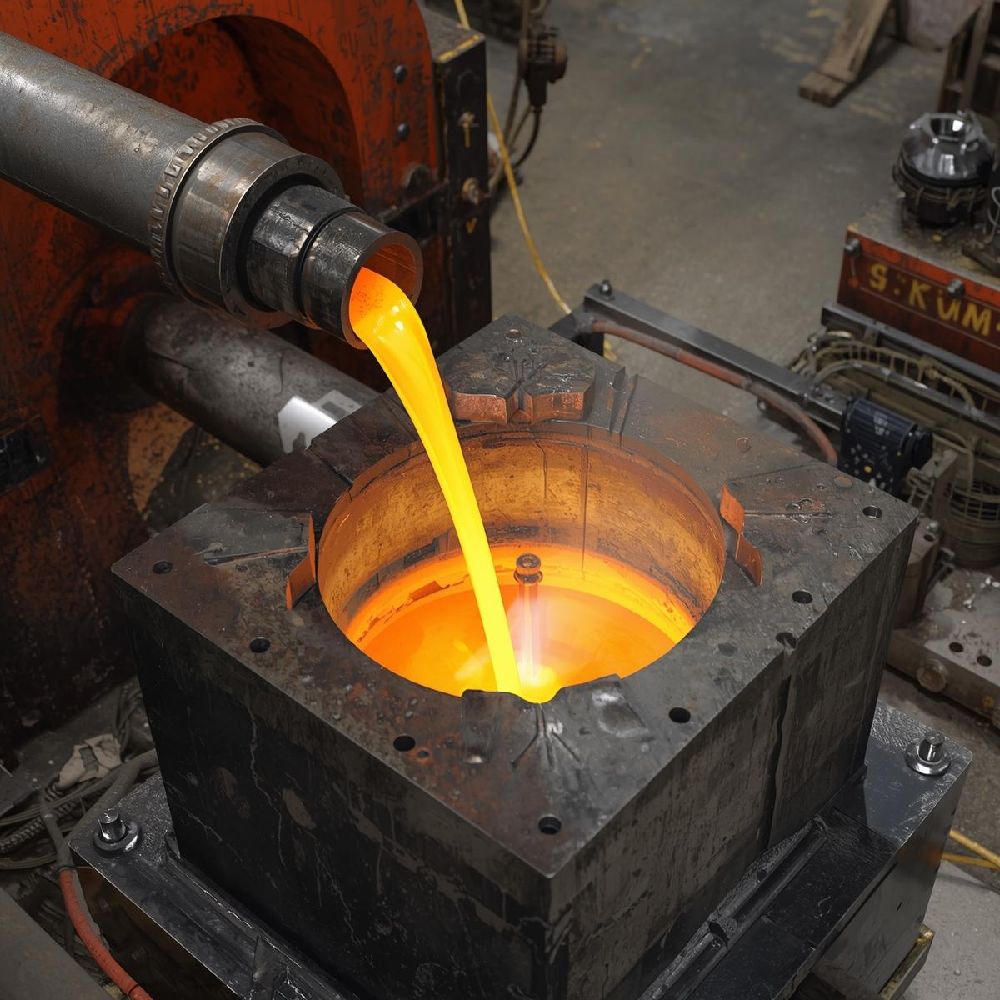
Pouring Molten Metal
Gold or other metals are melted at high temperatures and poured into the hollow mold. The metal takes the exact shape of the original wax model. -
Cooling and Mold Removal
After the metal cools and solidifies, the investment mold is broken away, revealing the rough jewelry piece. -
Finishing Touches
The jewelry is then polished, filed, and finished. Stones may be set, textures applied, or additional details added by hand or machine.
Why Casting Is Important in Jewelry
-
Precision and Detail: Even complex designs with tiny patterns can be reproduced perfectly.
-
Efficiency: Multiple identical pieces can be created quickly.
-
Flexibility: Allows for a wide range of shapes, sizes, and design complexity.
-
Durability: Properly cast jewelry is strong and ready for finishing processes.
Common Types of Jewelry Casting
-
Lost-Wax Casting: Most common; ideal for detailed designs.
-
Centrifugal Casting: Uses spinning motion to push molten metal into the mold.
-
Vacuum Casting: Uses vacuum pressure to ensure no air bubbles and precise detail.
Conclusion
The casting process is the heart of modern jewelry making, turning creative ideas into tangible pieces of art. By combining precision, efficiency, and flexibility, casting allows jewelers to produce beautiful, durable, and intricate designs. Whether it’s a simple gold bangle or an elaborate ring, casting makes every piece possible.