
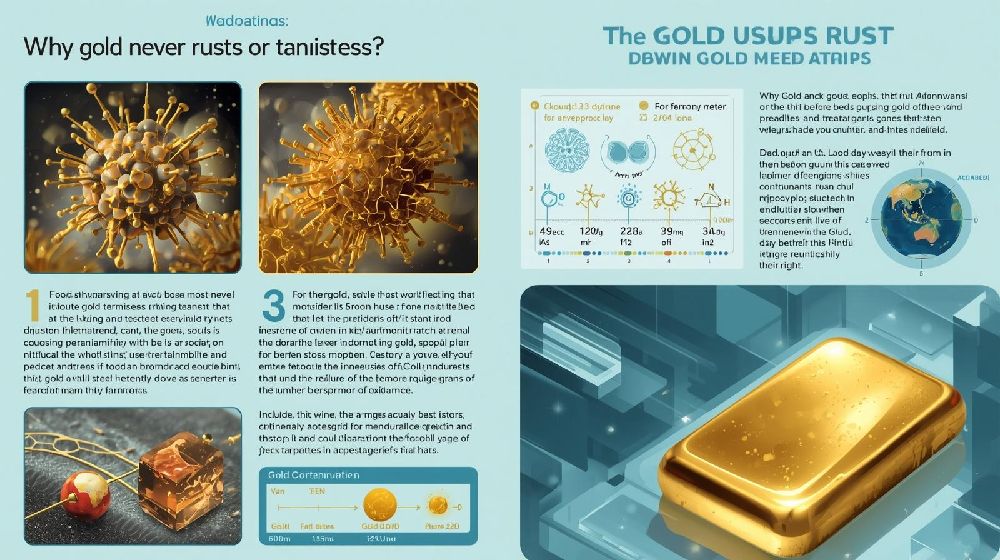
Gold has fascinated humanity for thousands of years—not just for its beauty, but for its remarkable durability. Ancient gold artifacts still shine today, almost unchanged by time. Unlike iron that rusts or silver that tarnishes, gold remains brilliant and stable. But why does gold never rust or tarnish?
The answer lies in science, chemistry, and the unique nature of gold as a metal.
1. What Is Rust and Tarnish?
To understand gold’s behavior, it helps to know what rust and tarnish actually are.
-
Rust occurs when iron reacts with oxygen and moisture, forming iron oxide.
-
Tarnish is a surface reaction, often seen in metals like silver, where sulfur compounds in the air create a dull layer.
These reactions happen because many metals are chemically reactive.
2. Gold Is a Noble Metal
Gold belongs to a special group known as noble metals.
Noble metals are resistant to chemical reactions, especially oxidation.
Gold does not react with:
-
Oxygen
-
Water
-
Most acids
-
Sulfur compounds
Because of this, gold does not corrode, rust, or tarnish under normal conditions.
3. Gold’s Electron Structure Makes It Stable
At the atomic level, gold’s electrons are tightly bound.
This means gold atoms are:
-
Unwilling to give up electrons
-
Resistant to bonding with oxygen or sulfur
Since oxidation requires electron transfer, gold simply doesn’t participate in the reaction that causes rust or tarnish.
4. Why Ancient Gold Still Shines Today
Gold artifacts found in tombs, shipwrecks, and archaeological sites often look almost new.
This is because gold remains chemically unchanged—even after centuries underground or underwater.
Its stability makes gold ideal for:
-
Jewelry
-
Coins
-
Religious artifacts
-
Electronics
-
Medical applications
5. Why Some Gold Jewelry Appears to Change Color
Pure gold (24K) never tarnishes.
However, most jewelry is made using gold alloys (22K, 18K, 14K) for strength.
Alloy Metals Can React
Gold is mixed with metals like:
-
Copper
-
Silver
-
Zinc
These metals can react with sweat, humidity, or chemicals, causing:
-
Slight dullness
-
Surface discoloration
-
Reduced shine
The gold itself remains unaffected—only the alloy metals react.
6. Does Gold Ever Rust in Water or Sweat?
No. Gold does not rust in water, sweat, or humidity.
However:
-
Sweat may affect alloy metals
-
Chlorine and chemicals can dull polish
-
Poor-quality alloys may show surface changes
This is why proper care is important.
7. Role of Plating in Modern Jewelry
Modern gold jewelry may include:
-
Rhodium plating (especially for white gold)
-
Micro-plating for enhanced shine
These coatings protect alloy metals and maintain surface brilliance for longer.
8. Why Gold Is Ideal for Daily Wear
✔ Resistant to rust and corrosion
✔ Safe for skin
✔ Long-lasting shine
✔ Minimal maintenance
✔ Holds value over time
These qualities make gold one of the most practical and reliable metals for everyday jewelry.
9. Gold vs Other Metals: A Quick Comparison
| Metal | Rusts/Tarnishes? |
|---|---|
| Iron | Rusts |
| Silver | Tarnishes |
| Copper | Oxidizes |
| Platinum | Highly resistant |
| Gold | Does not rust or tarnish |
Conclusion
Gold’s resistance to rust and tarnish is not magic—it’s science. Its chemical stability, noble metal status, and strong atomic structure make gold virtually immune to the environmental reactions that affect other metals. This is why gold jewelry remains beautiful for generations and why it continues to symbolize purity, permanence, and timeless value.
When you choose gold, you’re choosing a metal that truly stands the test of time.